
Conferences move fast.
We travel, change time zones or routines, sleep in unfamiliar beds, rush through breakfast, check emails before the first coffee, and then spend hours sitting in presentations, standing in exhibition areas, networking, talking, thinking, and absorbing information.
Our minds may be working at full speed while our bodies are doing surprisingly little.
That is one reason OMBO Yoga will bring a morning movement session to the HIPTHER Warsaw Summit this October:
HIPTHER Morning Reset – HIPTHER Warsaw Rhythm & Flow

The idea is not to turn conference delegates into yogis before breakfast.
It is much simpler: move the body before asking it to sit or stand for most of the day, breathe before entering another information-heavy environment, and create a transition between waking up and switching into professional mode.
And there is increasingly good research behind that idea.
Conferences are mentally active — but physically very sedentary
A conference day can easily include several hours of sitting, interrupted by periods of standing at networking sessions, booths or receptions.
Neither posture is inherently bad. The problem is staying in almost any one position for too long.
Research on office workers has repeatedly connected prolonged uninterrupted sitting with increasing physical discomfort, particularly around the neck and lower back. Experimental research has also found that interrupting sitting with short periods of standing or light movement can reduce discomfort, with some studies observing short-term improvements in alertness as well.
A conference is obviously not an office, but physically there are similarities: long periods of attention, screens, chairs, standing conversations, and relatively limited spontaneous movement.
Starting the morning with movement will not somehow cancel out eight hours of sitting. Movement during the day still matters.
But it can change how we begin that day.
Why yoga?
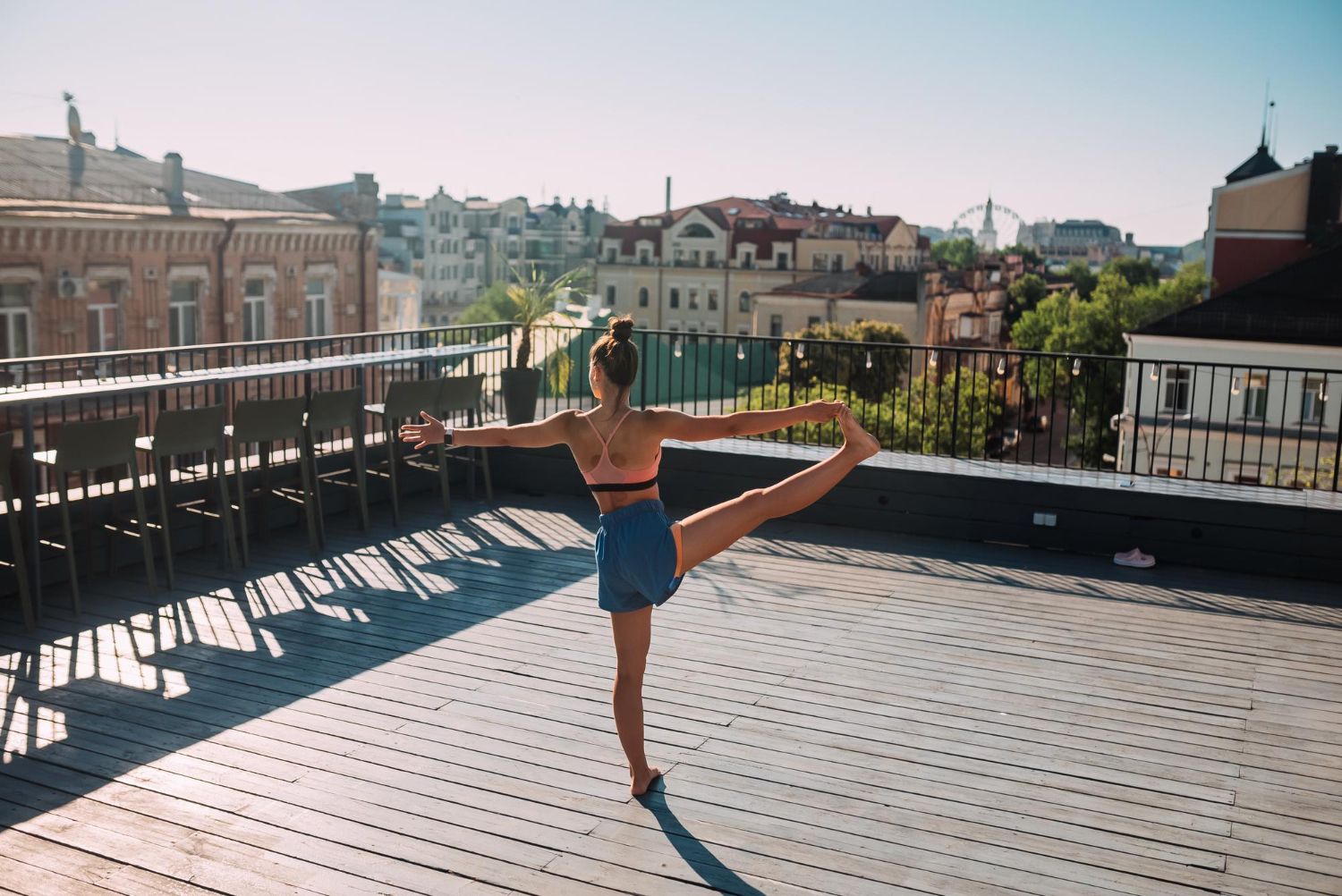
Yoga is particularly interesting in a professional environment because it doesn’t have to be an intense workout.
It combines movement, mobility, balance, breathing, and attention within the same practice.
A 2025 systematic review and meta-analysis examining yoga among desk-based workers included 15 studies, with 11 studies and 1,123 participants included in meta-analyses. Yoga was associated with improvements in several measures, including psychological and physical wellbeing, perceived stress, sleep quality and musculoskeletal discomfort, although the researchers also stressed limitations in the available evidence.
Workplace-specific research points in a similar direction. A systematic review and meta-analysis of workplace yoga interventions found a reduction in perceived work-related stress compared with control conditions, while an earlier systematic review concluded that workplace yoga appeared particularly promising for stress reduction.
More broadly, a 2024 systematic review and meta-analysis involving 13 randomized controlled trials found evidence that yoga may help reduce perceived stress in stressed adults, although the authors rated some of the evidence as low quality and called for stronger research.
That nuance is important.
At OMBO Yoga, we don’t need to claim that one morning yoga class will transform someone’s health. It won’t, but a thoughtfully designed movement session can create something valuable before a demanding day: space to move, breathe, wake up physically, and arrive mentally.
What kind of movement actually makes sense in the morning?
This is an important distinction.
HIPTHER Morning Reset – Warsaw Rhythm & Flow is not designed as a hard morning workout.
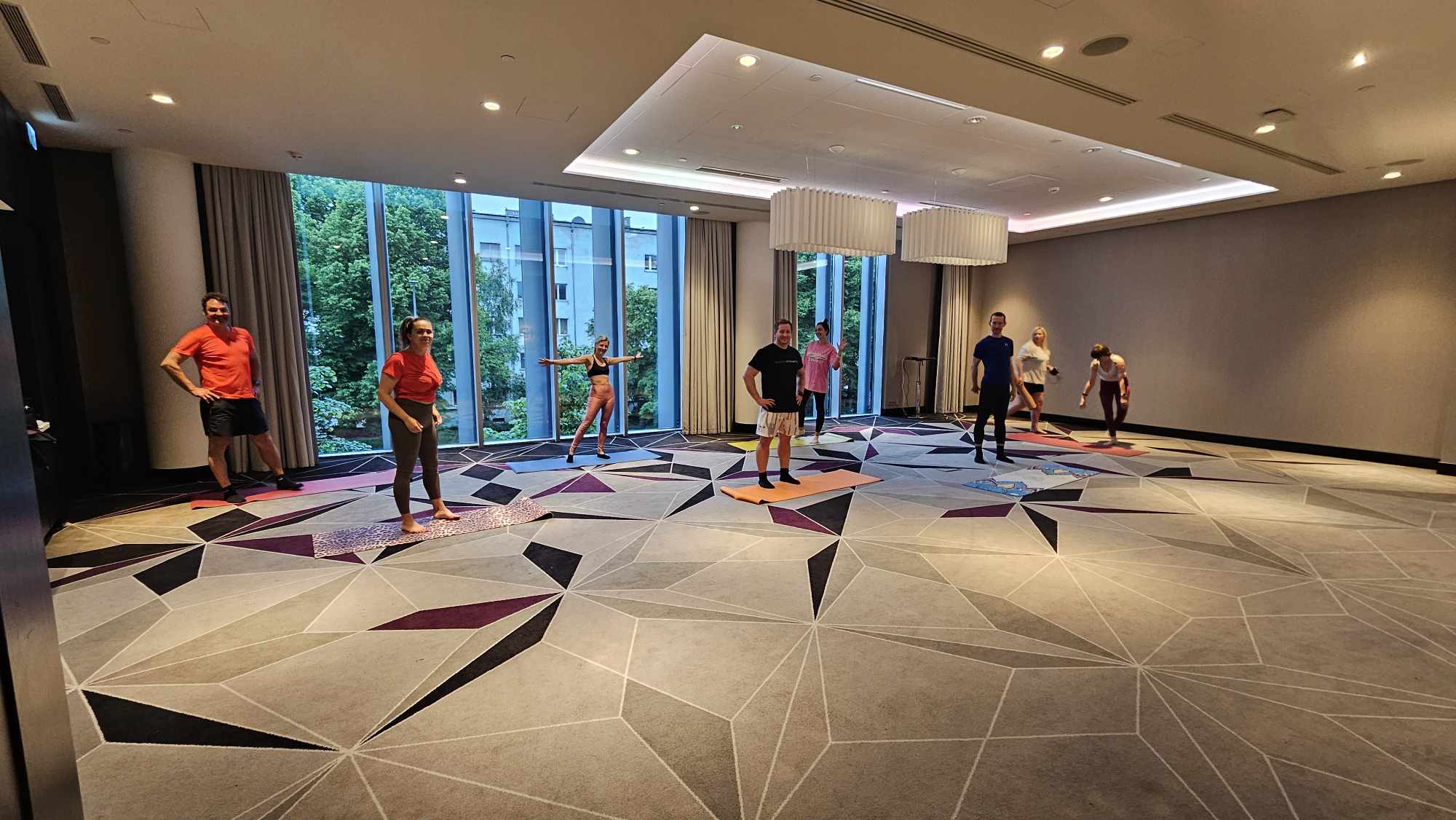
Participants may have travelled the previous day. Some may be regular athletes; others may rarely practise yoga. Some will be naturally mobile, others stiff. Somebody may have slept wonderfully; somebody else may have answered emails until midnight.
So everyone doing the same intense sequence makes little sense. A conference morning works better with progressive, low-to-moderate intensity movement.
We start gently and gradually create more movement as the body wakes up.
That can include:
– Breath and awareness. Before adding complexity, simply noticing breathing and posture can create a small transition out of the morning rush.
– Neck, shoulders and upper-back mobility. Shoulder rolls, gentle rotations, arm movements and thoracic mobility are particularly relevant before a day spent looking at screens, listening to presentations and talking to people.
– Spinal movement. Gentle flexion, extension and rotation can take the spine through movements it may receive very little of once the conference begins.
– Hips, ankles and legs. Standing all day can be tiring too. Hip mobility, ankle movement, calf activation and gentle leg work prepare the lower body without exhausting it.
– Dynamic yoga-inspired sequences. Rather than holding demanding positions for long periods immediately after waking, movements can flow naturally from one into another.
– Balance and coordination. Simple balance work asks the body and attention to communicate — without turning the morning into a fitness test.
– A short settling phase. The objective is not to finish exhausted. Ideally, participants leave feeling awake and composed.
And then we add something that matters enormously to this particular session:
rhythm.
Why “Rhythm & Flow”?
Movement doesn’t always have to feel clinical. Music changes the atmosphere of a room. Rhythm can make movement feel less like an exercise prescription and more natural, social, and enjoyable.
For Warsaw, HIPTHER Morning Reset – HIPTHER Warsaw Rhythm & Flow will blend gentle stretching and yoga-inspired movement with uplifting music and an easy, natural flow.
No complicated choreography.
No expectation that everybody moves identically.
No competition over who touches the floor, holds a pose longest, or looks most impressive doing it.
You follow the rhythm, but you also follow your own body. That is an important part of yoga too.
Autumn is actually a good time to rediscover rhythm
There is another reason we liked the idea of Rhythm & Flow for Warsaw in October. Autumn is a transition.
Summer travel ends, work accelerates, conferences return, days become shorter, and many of us gradually spend more time indoors.
Research suggests that human physical activity really does vary with the seasons. A systematic review covering 26 studies and approximately 9,300 participants across 18 countries found that activity levels were generally higher in summer and lower during other seasons, particularly winter, while sedentary behaviour tended to move in the opposite direction.
Another systematic review and meta-analysis examining annual patterns in adults also found evidence of seasonal variation in movement, sedentary behaviour and sleep.
That doesn’t mean autumn makes us biologically destined to become inactive.
It means that our environment changes, so maintaining movement may require more intention.
Perhaps autumn doesn’t need to mean pushing ourselves harder.
It can mean finding a different rhythm.
– Walking when we can, moving indoors when the weather turns.
– Using yoga and mobility to keep our bodies active.
– Taking breaks from the chair.
– Creating small rituals that help us move through increasingly busy schedules.
Yoga before sitting — and movement after yoga
There is one misconception worth avoiding.
Doing yoga at 8:00 in the morning does not permit us to remain immobile until dinner. The benefits of a morning session and the benefits of interrupting sedentary time are different things.
Research into prolonged sitting increasingly supports breaking up long sedentary periods with activity. A 2024 systematic review and meta-analysis of randomized crossover trials examined different frequencies of interruptions to prolonged sitting and their effects on cardiometabolic health, adding to a wider body of evidence supporting activity breaks rather than uninterrupted sitting.
So our ideal conference day would look something like this: Move in the morning. Then keep moving.
Walk between sessions.
Change position.
Take the stairs when appropriate.
Step outside for a few minutes.
Move your shoulders.
Stretch your legs.
Don’t feel obliged to remain glued to a chair simply because you are attending a business event.
Wellbeing doesn’t need a separate conference track; it can be woven into how the conference itself works.
Warsaw: our next morning reset
And this brings us to Warsaw.
On October 27, 2026, OMBO Yoga will join the HIPTHER Warsaw Summit with:
HIPTHER Morning Reset – HIPTHER Warsaw Rhythm & Flow
It will be a relaxed, beginner-friendly morning combining gentle mobility, yoga-inspired movement, stretching, music, breathing and flow.
There is nothing to prove.
You don’t need to practise yoga.
You don’t have to be flexible.
You don’t need fashionable yoga clothes, and you certainly don’t need to perform.
Come as you are, move at your own pace. Wake up your body before asking it to carry you through an intense conference day.
Perhaps that is the real meaning of a morning reset: not forcing ourselves into productivity from the moment we wake up, but creating enough space for the body and mind to arrive together.
Because meaningful conferences should move more than ideas — they should move people too.
See you in Warsaw. 🧘
Research referenced
The article draws on systematic reviews and research covering yoga for desk-based workers, workplace stress, prolonged sitting and active breaks, and seasonal changes in physical activity.
Yoga and wellbeing among desk-based workers – Applied Psychology, 2025
Yoga and stress – Frontiers in Psychiatry, 2024
Workplace yoga and perceived stress – PubMed
Seasonality and physical activity – PubMed