
A science-informed yoga practice for clarity in an age of media overload
You may believe that you are choosing what to watch, read, and believe, but often, your body reacts before your reasoning begins.
A frightening headline tightens your jaw. A notification interrupts your breathing. An angry video accelerates your pulse. Before you have checked the source, examined the evidence, or considered another perspective, your nervous system has already received the message:
“Something is wrong. React now.”
This is not proof that every news story is a lie or that every media platform is manipulating you deliberately. It is a reminder that much of the modern attention economy rewards urgency, conflict and emotional intensity, not calm understanding.
When the body remains in a state of agitation, mental clarity becomes harder. The solution is not to hide from reality. It is to stop surrendering your nervous system to every person, platform and algorithm demanding your reaction.
Information is not the same as understanding
The World Health Organization uses the word infodemic to describe environments containing excessive information, including false or misleading material. Such environments can create confusion, mistrust and difficulty making informed decisions.
Media itself is not automatically harmful. Digital platforms can educate, connect and inform us. The problem begins when consumption becomes excessive, fragmented or emotionally compulsive, or when headlines are negative all the time. A recent systematic review found mixed effects from social media: purposeful educational engagement may offer benefits, while excessive use, particularly patterns associated with addiction, has been linked with poorer attention, working memory and executive functioning in children and young adults.
Research also suggests that people who display a strong attentional bias toward smartphone-related stimuli may experience lower awareness of internal bodily sensations and greater physiological reactivity to those stimuli.
In simple terms: the more automatically your attention is pulled outward, the harder it may become to notice what is happening within you. And if you cannot feel your own body clearly, how easily can you distinguish your considered judgment from a reaction that was triggered seconds earlier?
Your nervous system cannot evaluate every alarm equally

When emotionally charged information reaches you, the first task is not necessarily to decide whether it is true. Your brain and body must first determine whether it represents a threat.
This is useful when danger is immediate. It is less useful when the “danger” is an endless stream of notifications, arguments, predictions and disasters delivered through a small screen.
The body may respond with:
- shallow or rapid breathing;
- tension in the face, shoulders or abdomen;
- restless scrolling;
- an urge to argue, share or check again;
- difficulty concentrating on ordinary tasks;
- exhaustion combined with an inability to stop consuming information.
These reactions do not mean you are weak. They mean your biology is responding to repeated stimulation. Also, biology is not destiny. You can interrupt the cycle.
Yoga should not help you escape reality
Yoga is sometimes sold as a soft refuge from an uncomfortable world: breathe deeply, think positively, and pretend everything is fine.
That is not clarity. That is avoidance.
But a serious yoga practice should make you more capable of facing reality without being mentally colonized by every emotional signal around you.
The purpose is not to replace evidence with intuition, just is to create enough physiological stability to examine evidence properly. Yoga cannot tell you whether a claim is true. It can help you become calm enough to investigate before reacting.
The Ombo Yoga Clarity Reset
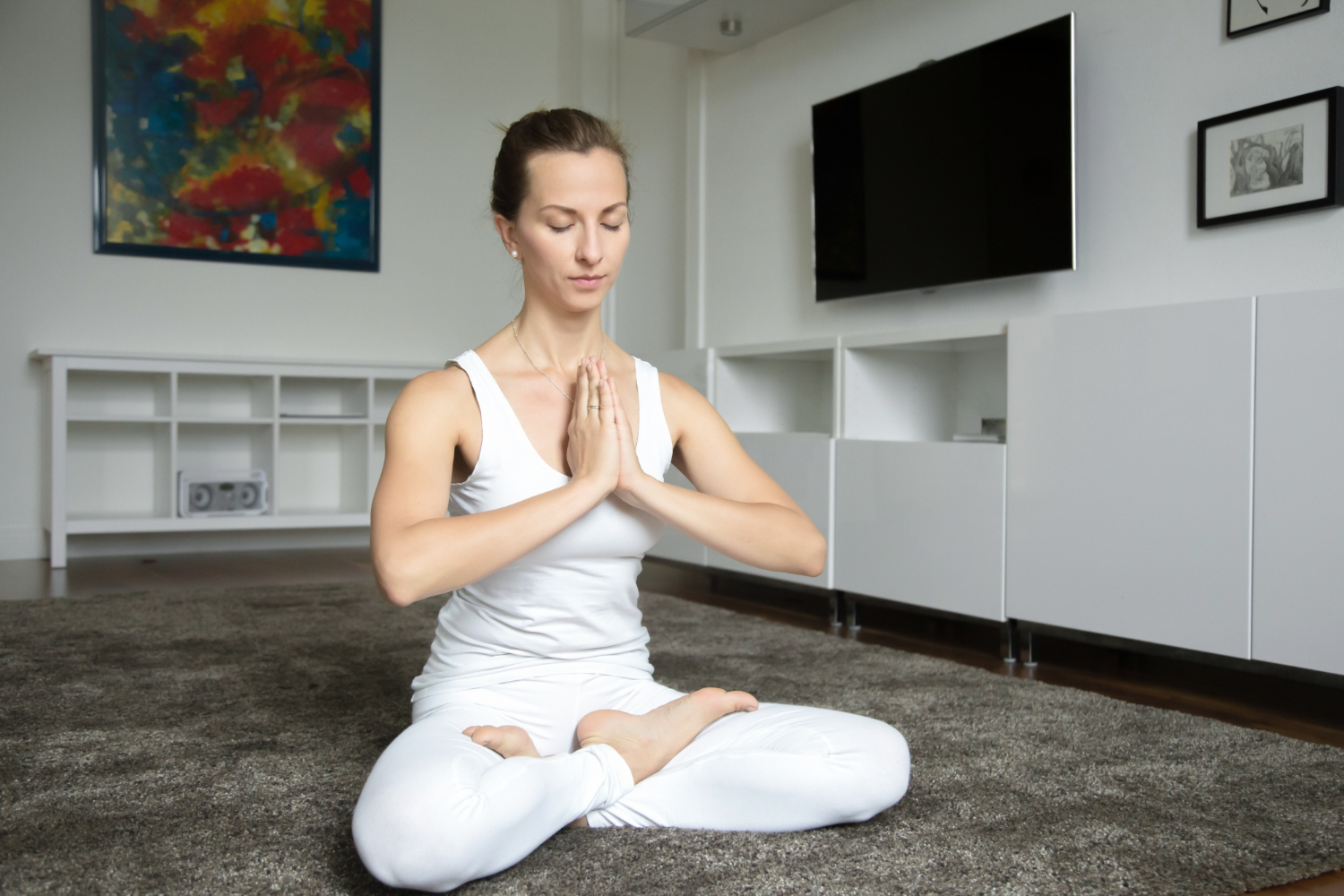
Use this 12-minute sequence after prolonged scrolling, before reading the news, or whenever you notice that media has changed your mood and taken control of your attention.
1. Remove the stimulus — 1 minute
Place your phone in another room, not beside the mat and not face down within reach. Do not negotiate with it.
One study found that even the mere presence of a switched-off smartphone could reduce attentional performance, suggesting that physical separation may support concentration.
Stand or sit quietly.
Ask yourself:
“What am I feeling before I consume anything else?”
Do not analyse the answer. Notice the body.
2. Orient to the real room — 1 minute
Slowly look around.
Name silently:
- five objects you can see;
- three sounds you can hear;
- one place where your body touches the floor or chair.
This shifts attention away from the abstract emergency inside the screen and back toward your immediate physical environment.
The headline may describe something real. But at this moment, you are also in a room, breathing, supported by the ground. Both facts can exist simultaneously.
3. Move the agitation — 3 minutes
Begin in Mountain Pose — Tadasana.
Press all four corners of each foot into the floor. Soften the knees. Lengthen the spine without stiffening it.
– Inhale and raise the arms. Exhale and fold forward into Uttanasana, bending the knees generously.
– Inhale and lift halfway. Exhale and fold.
Rise slowly to standing.
Repeat this sequence five times, moving at the pace of your breathing.
The purpose is to give restless physiological energy somewhere to go without turning it into another comment, share or argument.
4. Practise an exhale-led breath — 3 minutes
Sit comfortably or lie down.
Inhale gently through the nose. Exhale slowly through the nose or softly through the mouth, allowing the exhalation to be slightly longer than the inhalation.
A simple rhythm is:
- inhale for four counts;
- exhale for six counts.
Continue without strain.
A randomized controlled study comparing several five-minute breathing practices with mindfulness meditation found that structured breathwork improved mood and reduced physiological arousal, with the strongest results observed in an exhale-focused cyclic-sighing practice.
Do not force deep breaths. Bigger is not always calmer. Choose a quiet, comfortable breath; just stop if you feel dizzy or unwell.
5. Rest in constructive stillness — 2 minutes
Lie in Savasana, or rest on your back with the knees bent and feet on the floor.
Place one hand on the chest and one on the abdomen.
Notice:
- Is your breathing still hurried?
- Is your jaw gripping?
- Are you preparing an argument?
- Are you afraid of not knowing what happens next?
- Are you seeking information—or seeking relief from uncertainty?
Do not judge the answers.
Awareness is the point at which an automatic reaction can become a conscious choice.
A 2024 randomized trial found that even a single yoga class was associated with changes in several psychological and neurophysiological measures related to self-regulation, although more research is needed to clarify the contribution of yoga’s individual components.
6. Apply the three-question filter — 2 minutes
Before returning to any article, video or post, ask:
Is this information verified?
Can I identify the original source, date, evidence and context?
Is this information useful now?
Does it affect a decision I need to make, or is it merely keeping me activated?
Is my body calm enough to evaluate it?
Am I reading to understand, or reacting because I feel threatened, angry or afraid?
If the third answer is NO, wait.
Urgency is often a feature of content, not a command you are required to obey.
Build a body that protects the mind
Mental clarity is not produced only through better thoughts. It is supported by physical conditions. A sleep-deprived, underfed, immobile, and overstimulated body will not process information in the same way as a rested and regulated body.
To protect your clarity:
1. Create media windows
Choose specific times to check news and social media instead of allowing continuous access throughout the day.
Being constantly informed is not the same as being well informed.
2. Do not begin the day inside someone else’s agenda
Before opening your phone, feel your feet, drink water, breathe, and move.
Give your own nervous system the first word.
3. Read past the headline
Headlines are designed to gain attention. Understanding requires context.
Pause before sharing anything that confirms your fears, flatters your identity or gives you someone to hate.
4. Follow fewer, stronger sources
Ten contradictory accounts do not necessarily create balance. They may simply create noise.
Choose sources that show their evidence, correct mistakes and distinguish reporting from opinion.
5. Let the body veto compulsive consumption
When your shoulders rise, your breath shortens or your scrolling becomes automatic, treat that as a signal to stop.
Not forever. Long enough to recover your ability to choose.
Clarity is an act of resistance
The most radical response to media overload may not be shouting louder. It may be refusing to let every notification determine your internal state. It may be breathing before believing.
- Moving before reacting.
- Checking before sharing.
- Resting before concluding.
Yoga will not remove propaganda, misinformation, fear-based reporting, or algorithmic manipulation from the world. It will not make you immune to bias. It will not transform instinct into infallibility. But it can help you notice the exact moment when outside information becomes an inside storm. When you can feel the storm beginning, you no longer have to become it.
A final Ombo Yoga practice
The next time a piece of media makes you immediately furious or afraid, do not ask only:
“Is this true?”
First ask:
“What has this already done to my body?”
Then step away. Breathe. Move. Return with a nervous system capable of investigation rather than reflex.
Your attention is part of your life.
Do not hand it over unconsciously.
This article is for education and general well-being. Yoga and breathing practices are not substitutes for medical or psychological care. People with respiratory, cardiovascular, neurological or other health conditions should seek appropriate professional guidance and avoid breath retention or forceful breathing unless medically cleared.